Prime Highlights :
- WHO and GLIDE partner to accelerate disease elimination across the Eastern Mediterranean.
- The initiative targets 14 high-burden communicable diseases through integrated action.
Key Facts :
- The partnership strengthens disease surveillance, AI, and health systems.
- It also enhances polio surveillance to help sustain polio-free status.
Background :
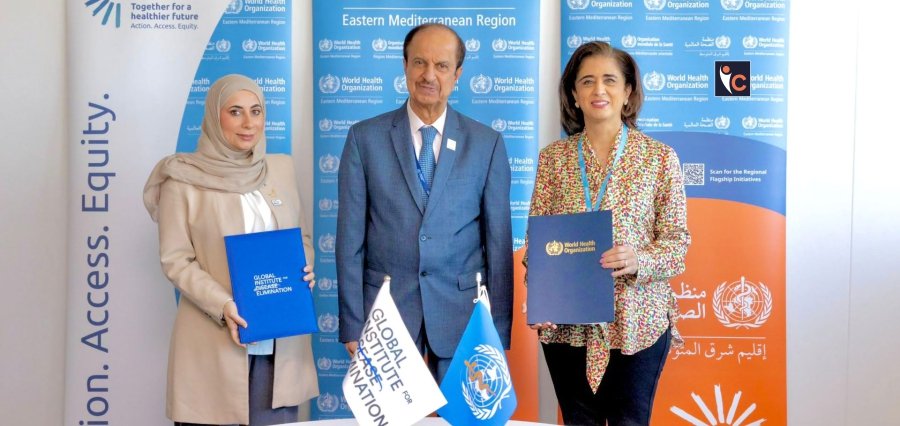
The World Health Organization’s Regional Office for the Eastern Mediterranean and the Global Institute for Disease Elimination have signed a partnership agreement aimed at speeding up the elimination of preventable communicable diseases across the region.
The collaboration brings together technical support, catalytic financing and country-led action to support integrated, lasting approaches to disease elimination.
H.E. Dr Farida Al Hosani, CEO of GLIDE, said the partnership advances the organization’s mission to eliminate preventable infectious diseases faster.
She said GLIDE’s research-driven approach and implementation expertise, combined with WHO’s regional leadership, will strengthen integrated surveillance and apply artificial intelligence to build stronger, more resilient health systems.
WHO Regional Director for the Eastern Mediterranean Dr Hanan Balkhy said the region’s challenges call for cross-border solutions and strong institutional partnerships.
She said the agreement supports the rollout of WHO’s multi-disease elimination framework and helps countries take the lead in identifying and removing infectious threats that slow community wellbeing and economic growth.
The partnership aims to strengthen disease surveillance systems and drive innovation and digital transformation in public health by building national capacity in artificial intelligence and advanced technologies.
It supports WHO’s new multi-disease elimination initiative, which initially targets 14 high-burden diseases through coordinated, shared health-system approaches while keeping disease-specific targets and monitoring intact.
The agreement also strengthens poliovirus surveillance, helping both endemic and polio-free countries sustain the vigilance needed to maintain their status. GLIDE and WHO said they plan to explore further areas of cooperation as the partnership develops.