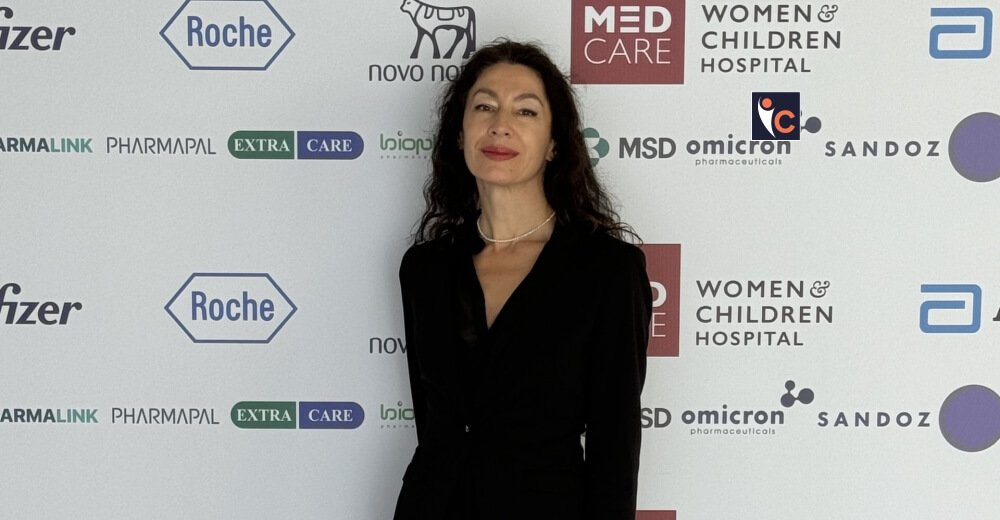
Originally from Kyiv, Ukraine, Dr. Iryna Shatokhina, MD, PhD, Specialist Endocrinologist, at Medcare Women & Children Hospital, began her journey in medicine through a deeply personal experience. When her grandmother was diagnosed with late-stage breast cancer and they had one of their last conversations, she encouraged her to pursue medical education so she could care for the people she loves. Her words became the foundation of her vocation.
Her passion for endocrinology grew through training and the guidance of remarkable mentors: Prof. MD Alexander Kuchinsky, who shaped her clinical thinking during her fellowship; Prof. MD Lubov Sokolova, whose insight guided her PhD; and Prof. PhD Andrii Kvacheniuk, a brilliant surgeon and endocrinologist, and an extraordinary person she remains in touch with to this day.
Endocrinology, to her, is a science of order; she is fascinated by the elegance of hormonal feedback systems and how small disruptions can cascade into disease, and it is a pleasure for her to link unrelated symptoms to a hidden endocrine cause. If she had to choose her career all over again, she would choose endocrinology every single time, without hesitation. It is her passion, her logic, and her way of making a difference.
Let’s delve into the interview details below!
As a Specialist Endocrinologist at Medcare Women & Children Hospital, what are your key roles and responsibilities in patient care and clinical practice?
My expertise lies at the intersection of reproductive endocrinology and maternal health, where I manage complex disorders in high-risk pregnancies – from gestational diabetes and thyroid dysfunction to PCOS. Beyond pregnancy, I focus on treating obesity, diabetes mellitus, and pituitary and adrenal disorders, alongside a personalized approach to menopause, metabolic syndrome, and osteoporosis.
In addition to clinical care, I collaborate as a speaker with the Board of Educators for the OB/Gyn Residency Program. I also lead the “Blossom” project, a city-wide initiative supporting and educating pregnant women. With over 19 years of clinical experience, medical practice for me is about more than treatment; it is about providing hope and compassion when patients need it most, especially in a hospital that is recognized among the world’s 150 best specialty hospitals.
How do you approach leadership and collaboration within multidisciplinary medical teams to ensure the best outcomes for patients?
The best outcomes are never achieved in isolation. My approach is grounded in listening, adaptability, and mutual respect. Treating complex cases demands rapid coordination across specialties; challenges evolve with us as physicians, and navigating them as a cohesive team is what elevates good outcomes into great ones.
What are some of the major challenges you have encountered in your endocrinology career, particularly while treating women and children, and how have they shaped your professional outlook?
Challenges have come in many forms.
During the COVID-19 pandemic at Oleksandrivska City Clinical Hospital in Kyiv, Ukraine, I managed 38 departments as a COVID-19 Endocrinologist, treating critically complex cases. Between the relentless night shifts, I prepared for and later passed my DHA Specialist Board Exam.
A different challenge met me in the UAE: the beautiful complexity of a truly multinational patient population. I studied cultural traditions, dietary habits, and Ramadan-specific guidelines to adapt international guidelines to local Emirates Endocrine Society standards.
In a rapidly evolving field like endocrinology, how do you stay updated with the latest medical innovations, research, and treatment approaches?
As a Board Member of the Dubai Endocrinology Journal — led by the remarkable Dr. Ihab El Tayeb — I engage with cutting-edge research before it reaches the mainstream. I also participate in premier forums, including the Emirates Diabetes & Endocrine Congress (EDEC) and World Obesity Federation SCOPE conferences. Innovation is only as effective as its application, and constant dialogue with global experts ensures our patients receive tomorrow’s care today. Recently, I completed a specialized distance advanced clinical training on Diabetic Retinopathy through Boston University, USA. Continuous education allows me to bring the most advanced day care back to my clinic.
How do you contribute to advancing patient care and innovation in endocrinology within your organisation?
We are bringing several meaningful innovations into daily practice. Advancing molecular diagnostic testing and oncomarkers for thyroid nodules allows us to identify malignancy risk early, reducing unnecessary surgeries. Early screening programs for diabetic retinopathy and neuropathy detect complications before they progress. The adoption of GLP-1/GIP receptor agonists has transformed our diabetes and obesity management, improving glycaemic control, weight reduction, and lowering cardiovascular risk.
A particularly significant advance has been in treating pregnant women with diabetes. Where insulin injections were once the only option, hybrid closed-loop insulin pump systems with continuous glucose monitoring now enable real-time automated insulin delivery, for example, the Medtronic 780G meets strict glycaemic targets and significantly improves outcomes for both mother and baby.
Are there any awards, recognitions, or professional milestones in your career that you consider particularly meaningful?
My PhD in Endocrinology was an important milestone — research on Type 2 Diabetes and Myocardial Infarction contributed original data to cardiometabolic health research. Securing my DHA Specialist Eligibility validated my expertise within one of the region’s most rigorous regulatory frameworks.
I have also been recognised among the top endocrinologists in Dubai by patient reviews, an honour I hold with great humility. But the reward I cherish most is a patient’s result. When patients recover and tell me I inspired them towards their well-being, they inspire me. They remind me why I chose this path. It is the only reward that truly matters.
Healthcare can be highly demanding; how do you maintain a healthy work-life balance while managing your clinical responsibilities?
I apply the same preventive medicine philosophy to my own life that I do for my patients. Chronic stress leads to allostatic overload, so I prioritise physical activity, whether ice-skating, pilates, or meditation, to regulate my own cortisol levels. I genuinely believe that a physician who takes care of herself is a more credible and inspiring presence for her patients. When they see that the advice I give them works in real life, it builds trust, and that trust is part of the treatment.
What advice would you offer to aspiring endocrinologists who aim to build a meaningful and impactful career in this specialty?
Get directly involved. Rotate through endocrinology clinics and inpatient services. Observe how specialists think, analyse data, and interact with patients. Participate actively: review cases, practise examinations, think like you are already a treating physician. Stay updated with the European Society of Endocrinology and the American Diabetes Association (ADA).
Start early, stay curious, and you will find your path.
Looking ahead, what are your future goals in advancing endocrinology care and contributing to medical innovation in the region?
True advancement in endocrinology can’t centre only around new tools. I believe in changing the way we think about disease, from reactive to predictive, always keeping the patient at the center of that transformation. This is why I want to help move endocrinology beyond symptom management toward genuine disease modification, using precision medicine, AI- assisted diagnostics, and genomics where the evidence supports them. The best outcomes I have seen always combine clinical innovation with an understanding of the whole patient, their culture, their circumstances, and their fears. That balance is what I want to keep building.